Why std::expected matters for error handling
C++23 introduced std::expected, changing how we handle errors without exceptions. When you combine it with std::error_code (available since C++11), you get an error handling approach that forces explicit error checks while keeping your code readable.
The real power comes from std::error_code carrying more than just a number. Through std::error_category, it associates error codes with human-readable messages and std::error_condition values, letting you classify errors by severity (fatal, warning, informational) rather than checking individual error codes.
When to use std::expected
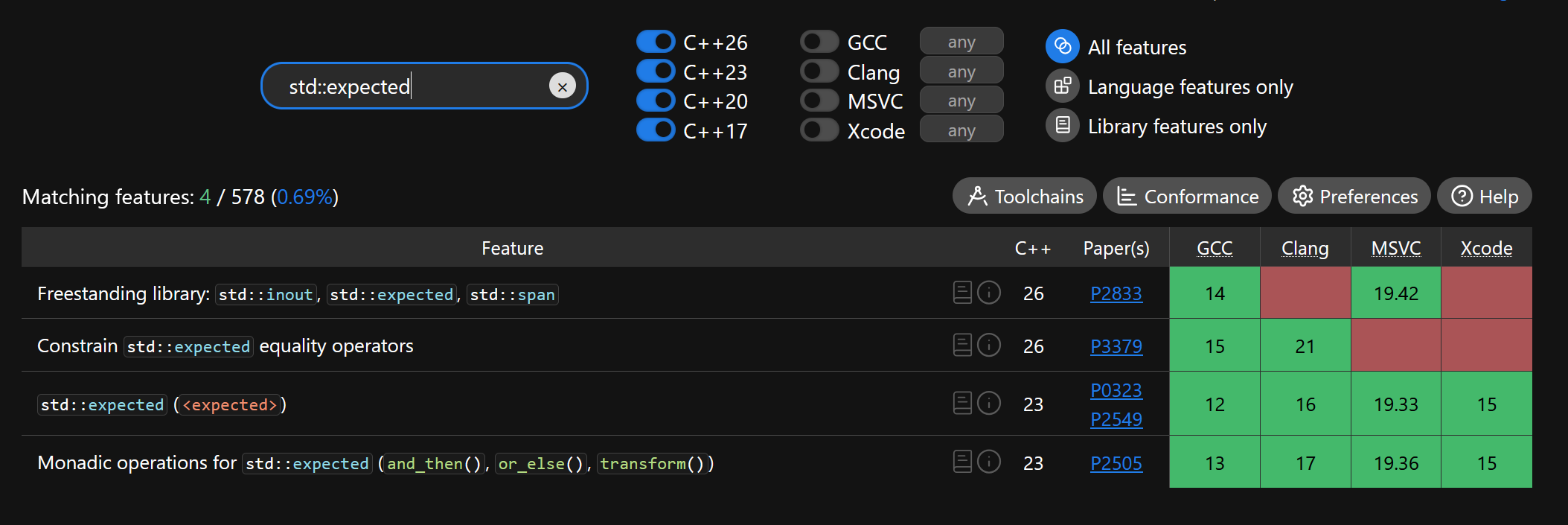
std::expected<T, E> shines when you need clear separation between success and failure:
- Type safety: The return value and error are distinct types. You can’t accidentally use an error as a valid result.
- Explicit checks: You must check for errors before accessing the value. No more forgetting to check return codes.
- Functional composition: Chain operations cleanly with
transform()andor_else():return readFile(path) .transform([](auto content) { return parse(content); }) .or_else([](auto error) { return handleError(error); });
When to combine it with std::error_code
std::error_code makes sense for non-throwing APIs where you need more context than a simple integer:
- No exceptions: Perfect for performance-critical code, embedded systems, or codebases with -fno-exceptions.
- Rich error context: Unlike
int VALUE_NOT_FOUND = 100, error codes come with categories and conditions. You can check if an error is “file-related” without knowing every possible file error code. - Cross-library consistency: Standard categories like
std::generic_category()andstd::system_category()work across different libraries.
The combination std::expected<T, std::error_code> gives you the best of both worlds—type-safe error handling with rich error information.
Why choose std::expected over std::error_code alone?
This is a common question, and the answer reveals the design philosophy behind C++ error handling.
std::error_code represents an error value, which typically is an integer code plus an error category. It’s powerful but requires discipline: you can accidentally ignore it, and the error is separate from your return value (often using output parameters or special sentinel values).
std::expected<T, E> takes a different approach. It’s a type-safe container that holds either a value or an error, never both, never neither. The compiler forces you to check which one you have before accessing the value. Think of it like Rust’s Result<T, E> or Haskell’s Either.
Here’s what sets them apart:
| Aspect | std::error_code | std::expected<T, E> |
|---|---|---|
| Type safety | Error separate from value; manual checks | Value and error bundled; compiler-enforced checks |
| Return style | Output parameters or sentinel values | Direct return type |
| Error propagation | Manual: if (ec) return ec; | Functional: .transform(), .or_else() |
| Forgetting to check | Possible—compiler won’t warn | Impossible—can’t access value without checking |
| Performance | Very cheap (integer + pointer) | Also cheap (no allocations, just a tagged union) |
| Best for | Legacy APIs, system integration | Modern APIs, composable code |
The best pattern? Use them together: std::expected<T, std::error_code>. You get type-safe control flow from std::expected plus standardized error reporting from std::error_code.
Practical examples
Traditional approach with std::error_code
Here’s the classic pattern—error code as return value, actual data as output parameter:
#include <fstream>
#include <filesystem>
#include <system_error>

std::string read_file(const std::filesystem::path& path, std::error_code& ec) {
    std::ifstream file(path, std::ios::binary);
    if (!file.is_open()) {
        ec = std::make_error_code(std::errc::no_such_file_or_directory);
        return {};
    }

    std::string content;
    file.seekg(0, std::ios::end);
    content.resize(file.tellg());
    file.seekg(0, std::ios::beg);

    if (!file.read(content.data(), content.size())) {
        ec = std::make_error_code(std::errc::io_error);
        return {};
    }

    ec.clear();
    return content;
}

int main() {
    std::error_code ec;
    std::string contents = read_file("foo.txt", ec);

    if (ec) {
        std::cerr << "Error: " << ec.message() << "\n";
        return 1;
    }
    // use contents...
}
This works, but notice:
- The function signature doesn’t clearly show what it returns
- You could forget to check
ecand usecontentsanyway - Output parameters make the API less composable
Modern approach with std::expected
The same functionality with std::expected is clearer:
#include <expected>
#include <fstream>
#include <string>
#include <system_error>
#include <filesystem>
#include <iostream>

std::expected<std::string, std::error_code>
read_file(const std::filesystem::path& path) {
    std::ifstream file(path, std::ios::binary);
    if (!file.is_open()) {
        return std::unexpected(std::make_error_code(std::errc::no_such_file_or_directory));
    }

    std::string content;
    file.seekg(0, std::ios::end);
    content.resize(file.tellg());
    file.seekg(0, std::ios::beg);

    if (!file.read(content.data(), content.size())) {
        return std::unexpected(std::make_error_code(std::errc::io_error));
    }

    return content;
}

int main() {
    auto result = read_file("foo.txt");
    if (!result) {
        std::cerr << "Error: " << result.error().message() << "\n";
        return 1;
    }

    std::cout << result.value();
}
Creating custom error categories with HTTP status codes
std::error_code becomes powerful when you define domain-specific categories. HTTP response codes are a perfect example—everyone knows what 404 or 500 means, but you still want to classify them generically (client error vs server error).
Here’s a real implementation for HTTP status codes:
// @file http_response_code.h

namespace network {
    enum class http_response_code {
        OK                    = 200,
        CREATED               = 201,
        NO_CONTENT            = 204,
        BAD_REQUEST           = 400,
        UNAUTHORIZED          = 401,
        FORBIDDEN             = 403,
        NOT_FOUND             = 404,
        INTERNAL_SERVER_ERROR = 500,
        SERVICE_UNAVAILABLE   = 503,
        // ... (complete list in actual code)
    };

    enum class http_error_condition {
        INFORMATIONAL = 100,
        SUCCESS       = 200,
        REDIRECT      = 300,
        CLIENT_ERROR  = 400,
        SERVER_ERROR  = 500,
    };

    const std::error_category& http_error_category() noexcept;
}

// Register with the type system
namespace std {
    template <>
    struct is_error_code_enum<network::http_response_code> : std::true_type {};

    template <>
    struct is_error_condition_enum<network::http_error_condition> : std::true_type {};

    inline std::error_code make_error_code(network::http_response_code code) noexcept {
        return {static_cast<int>(code), network::http_error_category()};
    }

    inline std::error_condition make_error_condition(network::http_error_condition cond) noexcept {
        return {static_cast<int>(cond), network::http_error_category()};
    }
}
// @file http_response_code.cpp

namespace network {
    class http_error_category final : public std::error_category {
    public:
        [[nodiscard]] const char* name() const noexcept override {
            return "http";
        }

        // Error codes close to messages.
        [[nodiscard]] std::string message(int ev) const override {
            switch (static_cast<http_response_code>(ev)) {
                case http_response_code::OK: return "OK";
                case http_response_code::NOT_FOUND: return "Not Found";
                case http_response_code::INTERNAL_SERVER_ERROR: return "Internal Server Error";
                // ...
                default: return "(unrecognized error)";
            }
        }

        // std::error_condition classification
        std::error_condition default_error_condition(int ev) const noexcept override {
            const auto code = static_cast<http_response_code>(ev);
            if (code >= http_response_code::OK && code < http_response_code(300))
                return std::make_error_condition(http_error_condition::SUCCESS);
            if (code >= http_response_code(400) && code < http_response_code(500))
                return std::make_error_condition(http_error_condition::CLIENT_ERROR);
            if (code >= http_response_code(500))
                return std::make_error_condition(http_error_condition::SERVER_ERROR);

            return std::error_condition(ev, *this);
        }

        bool equivalent(const std::error_code& code, int condition) const noexcept override {
            return *this == code.category() &&
                   static_cast<int>(default_error_condition(code.value()).value()) == condition;
        }

        bool equivalent(int code, const std::error_condition& condition) const noexcept override {
            return default_error_condition(code) == condition;
        }
    };

    const std::error_category& http_error_category() noexcept {
        static http_error_category instance;
        return instance;
    }
}
Now you can use it elegantly:
class http_response {
public:
    std::error_code code{};
    std::string     body{};

    [[nodiscard]] bool success() const noexcept {
        return code == std::make_error_condition(http_error_condition::SUCCESS);
    }
};

// Usage
auto response = http_client.get("https://api.example.com/users");

// Check specific code
if (response.code == http_response_code::NOT_FOUND) {
    std::cerr << "Resource not found\n";
}

// Or check generic condition - this is the power of error_condition
if (response.code == http_error_condition::CLIENT_ERROR) {
    // Handles 400, 401, 403, 404, etc. without checking each one
    std::cerr << "Client error: " << response.code.message() << "\n";
}

if (response.code == http_error_condition::SERVER_ERROR) {
    // Handles 500, 503, etc.
    retry_request();
}
The beauty here: you can check for broad categories (CLIENT_ERROR) without knowing every specific code. This is what makes std::error_condition valuable—it carries the semantic weight of error classification.
Chaining operations functionally
One of the biggest advantages of std::expected is composability. You can chain operations without nested if-statements. Here’s a real-world example from XML parsing:
// Get a child element by name
std::expected<XmlElement*, std::error_code>
get_child_element(XmlElement* parent, std::string_view name) {
    auto child = parent->first_child_element(name.data());
    if (!child)
        return std::unexpected(xml_errc::node_not_found);
    return child;
}

// Extract text from an element
std::expected<std::string, std::error_code>
get_element_text(const XmlElement* element) {
    const char* text = element->get_text();
    if (!text)
        return std::unexpected(xml_errc::node_empty);
    return std::string(text);
}

// Extract integer from an element
std::expected<int, std::error_code>
get_element_int(const XmlElement* element) {
    int value = 0;
    if (!element->query_int_text(&value))
        return std::unexpected(xml_errc::parse_error);
    return value;
}

// Compose them with error handling
template <class T>
auto get_element_value(XmlElement* parent, std::string_view name) {
    if constexpr (std::is_same_v<T, int>) {
        return get_child_element(parent, name)
            .or_else(log_parse_error(name))
            .and_then(get_element_int);
    } else {
        return get_child_element(parent, name)
            .or_else(log_parse_error(name))
            .and_then(get_element_text);
    }
}

// Usage - clean and error-safe
auto name = get_element_value<std::string>(root, "username");
auto age = get_element_value<int>(root, "age");

if (name && age) {
    process_user(name.value(), age.value());
} else {
    // Errors already logged via or_else
    return std::unexpected(xml_errc::invalid_user_data);
}
This is similar to Rust’s ? operator or functional programming’s monadic composition. Each step automatically propagates errors, and .or_else() lets you handle errors inline without breaking the chain. No nested if-statements, no manual error propagation—the type system handles it.
Lessons learned
After working with both std::error_code and std::expected in production code, here are the key takeaways:
Do:
- Use
std::expected<T, std::error_code>for new APIs—it’s self-documenting and safe - Create custom error categories for domain-specific errors
- Map custom errors to standard conditions via
default_error_condition() - Leverage functional composition with
.and_then(),.transform(), and.or_else()
Don’t:
- Mix error handling styles in the same API boundary (exceptions + error codes + expected)
- Forget that
result.value()throws if the expected contains an error—usehas_value()first or usevalue_or() - Create too many error categories—group related errors under one category
Performance notes:
- Both
std::error_codeandstd::expectedare zero-cost abstractions std::expecteduses a tagged union internally—no heap allocations- Error message strings are only generated when you call
.message(), not on construction
Migration path: If you’re converting an existing codebase:
- Start by wrapping
std::error_codeinstd::expectedat API boundaries - Gradually convert internal functions to return
std::expecteddirectly - Keep error categories consistent across old and new code
A critical gotcha: error categories must be in shared libraries
This is important and non-obvious: error category definitions must be in a compiled translation unit (.cpp file), not header-only. If you define your category in a header that gets included in multiple translation units, error comparisons will break.
Why? The standard library’s error_category equality comparison uses pointer identity, not value comparison:
// Inside std::error_category
bool operator==(const error_category& rhs) const noexcept {
    return this == &rhs;  // Pointer comparison!
}
If your category is defined in a header, each translation unit gets its own instance. The pointers differ, so comparisons fail—even though they represent the same category.
The fix: Always define your category instance in a .cpp file and return it by reference:
// http_response_code.cpp - NOT in the header!
namespace network {
    class http_error_category final : public std::error_category { /* ... */ };

    const std::error_category& http_error_category() noexcept {
        static http_error_category instance;  // Single instance
        return instance;
    }
}
Then in your header, only declare the function:
// http_response_code.h
namespace network {
    const std::error_category& http_error_category() noexcept;
}
This ensures every translation unit uses the same category instance, making pointer comparisons work correctly. This requirement ties error categories to compiled libraries—you can’t easily use them in header-only libraries without workarounds.
Conclusion
The combination of std::expected and std::error_code gives you the best of both worlds: type-safe APIs with rich, standardized error information. std::error_condition adds semantic weight by letting you classify errors generically (like HTTP’s client vs server errors) without checking individual codes.
It’s the current C++ way to handle errors without exceptions—just watch out for that category definition gotcha
The combination of std::expected and std::error_code gives you the best of both worlds: type-safe APIs with rich, standardized error information. It’s the current C++ way to handle errors without exceptions.